
What is Generational Trauma And How Is It Passed Down?
Most people think of trauma as something that happens to you. A car accident. An abusive relationship. A childhood you'd rather forget. You live through it, you carry it, and — hopefully — you heal from it.
But what if the trauma you're carrying didn't start with you?
This is not a metaphor. There is actual science behind the idea that trauma can be passed from one generation to the next through biology. It doesn't require you to live through the same experience. It doesn't even require you to know the experience happened. The effects can show up in your body, your brain, and your behavior — inherited the way you inherit eye color or a family nose.
What Epigenetics Actually Means
The word sounds complicated. The idea isn't.
Your DNA is like a blueprint. It contains instructions for how your body and brain are built. For a long time, scientists believed that blueprint was fixed — you got what you got, and that was that.
Epigenetics changed that understanding.
Epigenetics is the study of how experiences can change the way genes are expressed — meaning which instructions get turned on and which ones get switched off. The DNA itself doesn't change. But how the body reads it does.
Trauma is one of the experiences that can do this. Significant stress — especially chronic or severe stress — can alter gene expression in ways that affect the nervous system, the stress response, and emotional regulation.
And here is the part that matters: some of those changes can be passed to the next generation.
The Research That Changed Everything
The most well-known studies on this topic looked at Holocaust survivors and their children.
Researchers found that the children of survivors showed measurable differences in their cortisol levels — the hormone tied to the stress response. Their systems were calibrated differently. Not because of what they had lived through, but because of what their parents had.
Similar findings have come from studies on children of people who were pregnant during the 9/11 attacks, descendants of people who experienced famine, and the offspring of animals exposed to significant stress. Across different types of trauma, in different populations, the pattern holds.
Stress leaves a biological mark. That mark can travel.
What This Looks Like in a Real Person
You might be reading this and thinking about yourself.
Maybe you've always been hypervigilant — scanning rooms, bracing for something bad, never fully able to relax — even though your own life has been, by most measures, fine. Maybe anxiety has followed you without a clear source. Maybe you carry grief that feels older than you are.
That's not imagination. That's not weakness. That could be your nervous system responding to something it inherited — a stress response that was shaped before you were even born.
It's also worth saying: this isn't only about what gets passed down. It's about what doesn't get passed down when someone heals. When a parent does the work to regulate their nervous system, process their trauma, and build safety in their body, that changes the biology they're passing on. Healing is inheritable too.
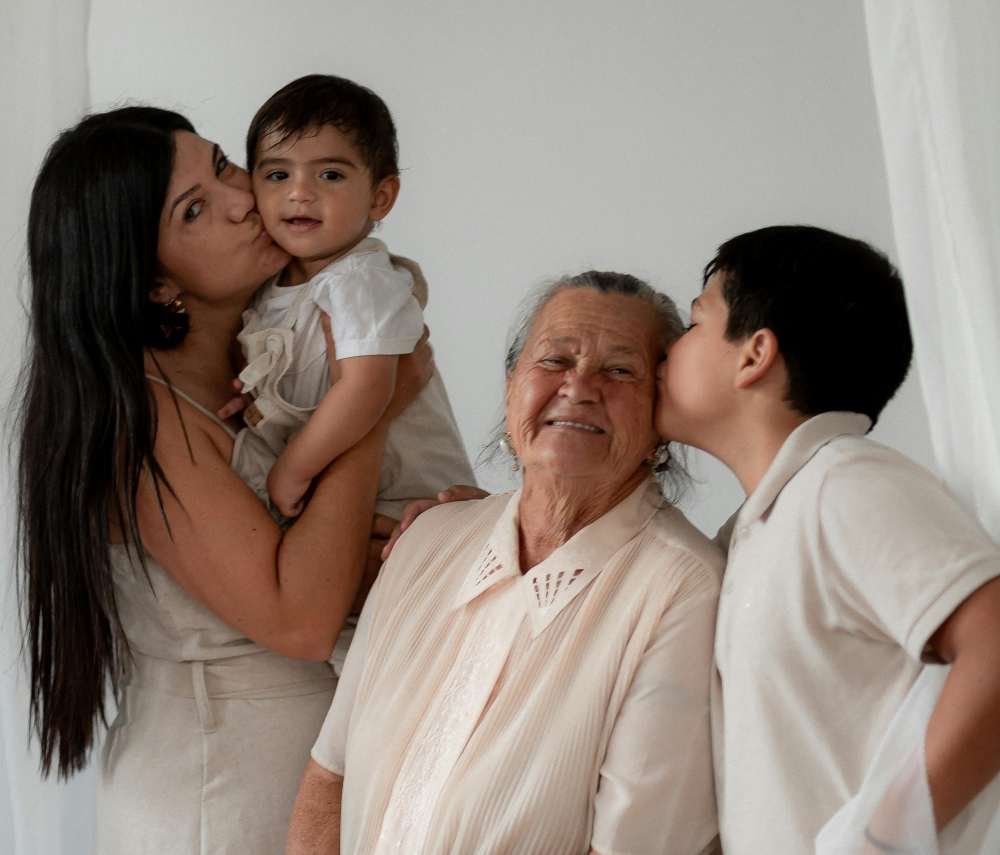
When a parent does the work to regulate their nervous system, process their trauma, and build safety in their body, that changes the biology they're passing on. Healing is inheritable too.
What This Doesn't Mean
Genetic transmission of trauma does not mean you are broken. It does not mean your fate is decided. And it does not mean your family is to blame.
Biology is not destiny. The same research that shows trauma can be passed down also shows that the effects can be changed. Therapy, specifically trauma-focused approaches, creates measurable changes in the brain and nervous system. Regulation practices, relationships, and safety — over time — can rewrite the patterns that were handed to you.
You didn't choose the body or nervous system you were born into. You have more say than you think in how that story ends.
Why This Matters
Understanding genetic trauma transmission is not about giving people an excuse or a diagnosis to hide behind. It's about giving people an accurate picture of what they're working with.
When you know that your anxiety might be older than you, something shifts. The self-blame softens. The confusion makes more sense. And the path forward becomes a little clearer.
Trauma is not just a personal story. It's a biological one. And biology — with the right support — can change.
Ready to Stop Carrying What Was Never Yours to Carry?
If something in this post landed, that's worth paying attention to.
Generational trauma lives in the body. That means talk therapy alone doesn't always reach it. You can understand your family history perfectly and still feel stuck — because understanding and healing are not the same thing. The body needs its own path to process what it's been holding.
That's where Brainspotting comes in.
Brainspotting is a brain-body therapy that works by locating specific eye positions — called brainspots — that are connected to unprocessed trauma stored in the nervous system. Where you look affects how you feel. By finding and holding these spots, the brain is able to access and process trauma that sits below the level of conscious thought.
This makes it especially effective for generational trauma. When you can't put the pain into words — when it lives in your gut, your chest, your constant low-level dread — Brainspotting gives your nervous system a way to process it without needing a story attached. You don't have to know exactly what happened to your grandmother. Your body already does.
If you are tired of managing symptoms that never fully go away, if you've tried to talk your way through something and it won't budge, or if you've always sensed that what you're carrying is bigger than just you — I offer trauma therapy in-person in Grand Rapids, MI and virtually across Michigan, Florida, and Arizona. Reach out for help.